



A Practical Guide to Tummy Time, Development and Safety
As a paediatric physiotherapist working solely with babies and toddlers, some of the most common questions parents ask me are: “How much tummy time is enough?”, “What if my baby hates tummy time?” and “How do you do it safely?” Tummy time certainly is one of the most important yet confusing things you can do for your baby’s development, and as a result, much of the advice I give parents revolves around implementing it. Here’s a practical guide to get you started.
Why Tummy Time Matters
In the past, babies spent much of their day lying on their tummies, including sleeping overnight. We now realise this is unsafe and today’s sleep guidelines explicitly state that babies should sleep on their backs, which protects against cot death. There is no question of following these guidelines, however, the unintended result is that many babies now spend between 12 and 19 hours a day flat on their backs! This is because not only do they sleep like this, but most babies are now spending many hours on their backs in car seats, pushchairs, baby bouncers and baby gyms.
This obviously means significantly reduced tummy time for our babies. Time on the tummy is what helps our babies:
- Build core and upper body strength.
- Learn to push on their hands and arms, preparing them for crawling as well as fine motor control.
- Stretch out the front of the body to elongate structures that are shortened by the foetal position in the womb.
- Develop head and neck control.
All of which is essential for learning to roll, sit and crawl, and later walk. With ever decreasing amounts of tummy time, it’s becoming more and more common to see babies who are slower to reach their gross motor milestones.
Tummy time also means that your baby avoids pressure building up on one part of the head, and so it is becoming more common nowadays for babies to develop flattening on the back or side of the head.

Did You Know?
Tummy time does not always have to take place on the floor. Your baby can also enjoy supervised tummy time while lying on your chest, making it easier to incorporate into everyday routines.
How Much Tummy Time Does Your Baby Need?
In short: More than you think! It’s almost impossible to do too much. It is essential that babies continue to be put to sleep on their backs, so approaching tummy time has to be during the remaining daytime hours when your baby is awake and supervised.
Tummy time doesn’t only mean your baby lying on the floor for lengthy periods, or that your baby needs to be working really hard. During the day when your baby is supervised, tummy time can be done in several forms:
- Lying on your chest while you hold or feed them.
- Active, floor-based tummy time where you’re playing and interacting with your baby.
- Although it is not tummy time, allowing your baby to lie on their sides is also a break from being on their back.
A Few Important Safety Tips
Tummy time should always take place when your baby is awake and under adult supervision.
Always place your baby on their back for sleep, including daytime naps. For floor-based tummy time, use a firm, flat surface and avoid soft pillows or loose bedding.
If your baby falls asleep during tummy time, gently move them onto their back in a safe sleeping space. Never fall asleep while your baby is lying on your chest.
Making Tummy Time Easier for Your Baby
If your baby struggles with tummy time, a few small adjustments can make a big difference:
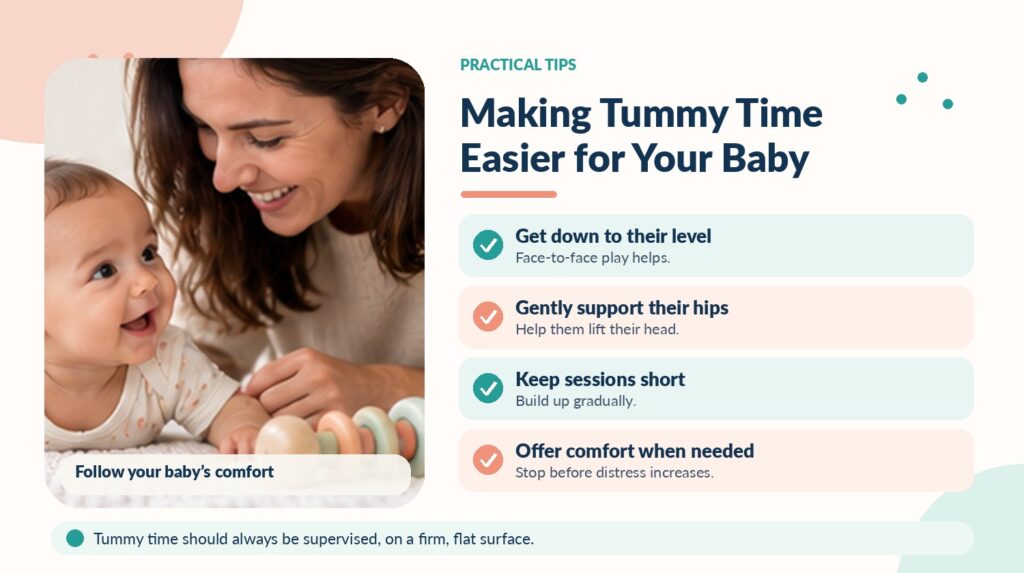
Get down to their level: Lie face-to-face or right beside them so they’re not doing it alone.
Anchor the bottom: A gentle, firm hand on the bottom stabilises the hips and frees up the chest, making it easier for your baby to lift their head.
Elevate the chest slightly: A small wedge (a rolled towel or a slight incline) so the chest is a little higher than baby’s hips reduces the effort needed to lift the head.
Let younger babies rest looking to the side: In the early weeks, allow your baby to rest their head to one side during supervised tummy time, position your baby’s hands on either side of their head and gently guide their hand to their mouth so they can self-soothe. Keeping their hands close to their face may help them feel comfortable and soothe themselves.
Older babies with head control: Place their elbows directly below their shoulders so that they can lean on their forearms in a “plank position”.
Build up gradually: If your baby protests, don’t push through distress. Try a short burst, offer comfort, and try again. Little and often works better than forcing longer sessions.
Key Take-Home Message
Don’t be afraid of tummy time! When it is done within safe guidelines, it’s genuinely difficult to give your baby too much of it. Start with your baby on your chest from day one if you can, and slowly build it up. If your baby is a little older or resistant, use the tips above to make it easier and keep sessions short and repetitive, stopping before they become distressed. Every small session adds up and helps to promote your baby’s development and wellbeing.
Lisa Rogers is a paediatric physiotherapist who specialises in the early years. She sees babies and toddlers both remotely and from her clinic in Wimbledon. Lisa is also the host of the Best for Baby Podcast.